How to Evaluate a Tennis Court: Surface, Drainage & Orientation
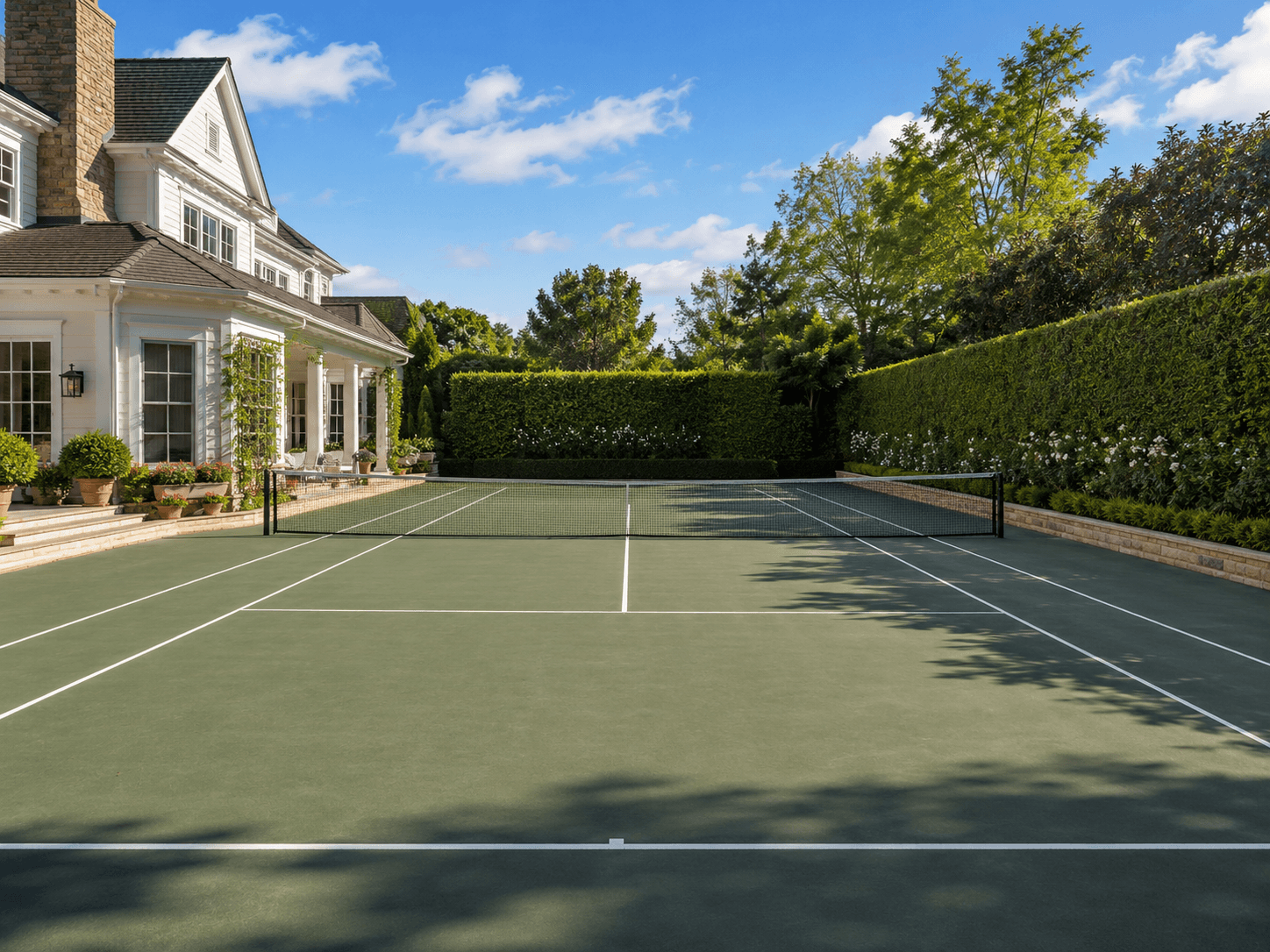
Why Residential Tennis Courts Fail (And Why Most People Miss It)
Residential tennis courts don’t fail because people play too much tennis.
They fail because they were never built like real tennis courts in the first place.
This is the first mistake almost everyone makes when evaluating a home with a court: they assess it like a feature, not like a structure. They ask whether the lines are visible, whether the color looks fresh, whether the fence is intact. They bounce a ball a few times, maybe take a couple of swings, and mentally check the box: “Usable.”
That mindset is exactly how expensive problems get inherited.
A tennis court is not a finish. It’s not a surface. It’s not paint and lines and vibes. It is a large, exposed, precision structure sitting outdoors, absorbing water, heat, cold, impact, and ground movement year after year. If the structure underneath is wrong, everything on top of it is cosmetic.
And residential courts are especially vulnerable because they’re often built last, value-engineered hardest, and inspected least.
The “It Looks Fine” Trap
The most dangerous tennis court is not the one with obvious cracks and weeds. That one at least announces its problems. The truly risky court is the one that looks freshly resurfaced.
New color coats hide everything:
Structural cracks
Differential settlement
Poor slope
Drainage failures
Patchwork repairs beneath the surface
A court that was resurfaced within the last 12–24 months can be worse than one that hasn’t been touched in ten years. Resurfacing is cheap compared to rebuilding, which makes it the go-to move for sellers trying to reset the clock visually without fixing the underlying issue.
If you remember only one thing from this entire guide, let it be this:
Surface condition tells you almost nothing about structural condition.
Why Residential Courts Are Built Wrong So Often
There are a few systemic reasons residential courts fail more frequently than club or municipal courts.
1. They’re not built by tennis specialists
Many residential courts are built by:
General concrete contractors
Landscaping companies
Excavation crews subcontracting the finish
They know how to pour slabs. They do not know how tennis courts behave over decades. Things like net-line stress, baseline wear zones, slope tolerances, and drainage redundancy are often ignored entirely.
2. They’re value-engineered aggressively
Developers and homeowners almost always try to shave cost:
Thinner slabs
No post-tensioning
Minimal subgrade prep
Shared drainage with landscaping
Asphalt instead of concrete “because it’s cheaper”
Each of these saves money upfront. Every single one increases long-term failure risk.
3. They’re exposed to everything
Unlike interior features, a tennis court is punished daily by:
UV radiation
Thermal expansion and contraction
Rain saturation
Freeze–thaw cycles
Tree roots and soil movement
If the court isn’t designed for your specific climate, it will age badly no matter how little it’s used.
The Three Ways Courts Actually Die
Most courts fail through one (or more) of these mechanisms:
1. Structural Movement
This is the silent killer.
When the subgrade isn’t properly compacted or when drainage allows water to soften the soil beneath the slab, different sections of the court begin to move independently. You don’t notice it at first. The movement is measured in millimeters. But tennis is unforgiving—tiny changes affect bounce, footwork, and joint stress.
Early signs:
Hairline cracks near the net line
Cracks that reappear after being filled
Low spots that hold water briefly after rain
Late-stage signs:
Wide cracks you can feel underfoot
Multiple elevation planes across the court
Permanent puddling
Once this starts, resurfacing is pointless. You are chasing a moving target.
2. Drainage Failure
Drainage is not about puddles. It’s about soil stability.
A court can look perfectly sloped and still fail if water has nowhere to go after it runs off the surface. Perimeter drains that clog, daylight drains that back up, or courts tied into garden drainage systems are all common failure points.
Water that saturates the subgrade reduces bearing capacity. The slab settles unevenly. The court doesn’t crack because it’s old—it cracks because the ground underneath it is no longer doing its job.
3. Thermal Stress
Concrete and asphalt expand and contract. That’s unavoidable. What is avoidable is failing to control that movement.
This is where post-tensioned concrete matters enormously (and where most residential courts cut corners). Without post-tensioning, slabs rely on thickness and reinforcement alone. In climates with large temperature swings, that’s often not enough.
Uncontrolled thermal movement leads to:
Random cracking
Crack propagation through resurfacing layers
Edge curling and separation
Once cracks form, water gets in, freezes, expands, and accelerates the failure cycle.
Why Tennis Courts Are Uniquely Unforgiving
Many outdoor features can tolerate imperfection. Tennis courts cannot.
A patio can slope unevenly and still function. A driveway can crack and still be driven on. A tennis court demands:
Flatness within tight tolerances
Consistent bounce
Predictable footing
Uniform drainage
A court that’s “mostly fine” is not fine. It’s actively hostile to good play and hard on the body. Knees, ankles, hips, and backs pay the price for uneven surfaces long before the eye catches up.
The Real Question You Should Be Asking
The wrong question is:
“Is this tennis court usable?”
Almost any court is usable for a while.
The right question is:
“What phase of its lifecycle is this court in?”
Is it:
Early life, properly built, structurally sound?
Mid-life, maintained but approaching major work?
Late life, cosmetically refreshed but structurally exhausted?
This guide exists to help you answer that question with confidence—before you inherit a six-figure rebuild disguised as a nice amenity.
The Foundation — Subgrade Prep, Slab Design & Why Post-Tensioned Concrete Is the Make-or-Break Factor
If you only ever read one technical section in this entire guide, make it this one.
Surfaces wear out. Paint fades. Lines get redone. Nets get replaced.
Foundations do not get do-overs.
Every good tennis court you’ve ever played on—whether you noticed it or not—was defined by what you couldn’t see: what was underneath your feet. Every bad court, too.
Residential tennis courts fail disproportionately often because the foundation is where shortcuts are taken. It’s expensive, invisible, and easy to disguise later with a fresh color coat. But once it’s wrong, nothing above it will ever be right.
Let’s break it down properly.
1. Subgrade Preparation: The Part Everyone Rushes (and Pays for Later)
The subgrade is the native soil beneath the court, and it matters more than almost anything else.
A tennis court is not like a driveway. It is a large, flat slab that demands uniform support across its entire footprint. If even one section of soil behaves differently—retains more water, compresses more under load, freezes more aggressively—the slab above it will respond by cracking or shifting.
What Proper Subgrade Prep Actually Looks Like
A well-built court typically includes:
Removal of organic material (topsoil, roots, debris)
Engineered fill brought in if native soil is unsuitable
Layered placement in lifts (not dumped all at once)
Mechanical compaction to specific density targets
Proof rolling to identify soft spots
Geotextile fabric where soil conditions require separation
This is slow, expensive work. It’s also the first thing to get cut when budgets tighten.
Common Residential Shortcuts
Here’s what happens far too often:
Excavation stops as soon as it “looks flat”
Soil is compacted visually, not mechanically
Soft spots are ignored because they’re “probably fine”
No soil report is done
Drainage assumptions are made instead of tested
These shortcuts don’t cause immediate failure. They cause delayed failure—which is worse, because it transfers the cost to the next owner.
How Subgrade Failure Shows Up Years Later
Subgrade issues rarely present as a single dramatic crack. Instead, you’ll see:
Clusters of cracks in specific zones
Repeated cracking in the same repaired locations
Slight depressions that hold water after rain
A court that “feels dead” or uneven underfoot
Once the soil beneath a slab starts behaving inconsistently, resurfacing becomes a cosmetic ritual, not a solution.
2. Slab Thickness: Inches Matter More Than You Think
Concrete thickness is one of the easiest places to cut cost—and one of the most expensive mistakes long-term.
Typical Thicknesses You’ll See
4 inches: Common in residential builds, often inadequate
5 inches: Acceptable with excellent subgrade prep
6 inches: Preferred for durability and long-term performance
A 4-inch slab can perform well only if everything else is perfect: soil, drainage, reinforcement, climate. That’s rarely the case.
Why Thin Slabs Fail
Thin slabs have less ability to bridge over minor soil movement. When the subgrade shifts, stress concentrates faster, cracks form sooner, and repairs become frequent.
Once cracking begins, water infiltration accelerates the problem, especially in freeze–thaw climates.
3. Reinforced Concrete vs Post-Tensioned Concrete
This is where courts separate into two very different categories.
Standard Reinforced Concrete
Traditional reinforced slabs use rebar or wire mesh embedded in the concrete. This reinforcement helps control cracking, but it does not prevent it. Cracks still form—they’re just held together.
For small slabs, that’s fine. For large, exposed slabs like tennis courts, it’s often not enough.
Post-Tensioned Concrete: What It Is (and Why It Matters)
Post-tensioned (PT) concrete uses high-strength steel cables installed within the slab and tensioned after the concrete cures. This places the slab in compression, counteracting the tensile forces that cause cracking.
In simple terms:
Reinforcement reacts to cracks
Post-tensioning actively prevents them
Why PT Is Ideal for Tennis Courts
Controls cracking across large slab areas
Improves performance in temperature extremes
Allows the slab to behave as a single unit
Dramatically extends lifespan
This is why serious courts—club-level, institutional, and high-quality residential builds—favor post-tensioned slabs.
Why Residential Courts Often Skip It
Because it costs more upfront, requires specialized contractors, and can’t be easily explained to homeowners who don’t know what they’re paying for.
Ironically, PT slabs often end up cheaper over 30 years because they:
Need fewer structural repairs
Resurface more predictably
Fail later and more gracefully
4. Joints, Cracks, and the Myth of “Crack-Free” Courts
No concrete slab is truly crack-free. The goal is to control where cracking occurs—or prevent it from occurring at all through compression.
Control Joints
Some courts rely on control joints to manage cracking. These are planned weak points where cracks are allowed to form.
The problem? Control joints interrupt surface uniformity and can affect play. They also telegraph through resurfacing layers over time.
Random Cracks
Random cracks are always a red flag. One or two hairline cracks may be manageable. Multiple intersecting cracks usually indicate structural or subgrade issues.
PT Slabs and Cracks
Well-designed PT slabs may develop micro-cracking, but significant cracking is uncommon. When it does occur, it’s usually localized and more manageable.
5. Questions You Should Ask (and How to Interpret the Answers)
When evaluating a court, ask these questions calmly and directly:
Was a soil report done before construction?
How thick is the slab?
Is it reinforced or post-tensioned?
Who built the court?
Have any structural repairs been done?
What matters isn’t just the answer—it’s how quickly and confidently it’s delivered.
Vague responses like:
“It was built to standard”
“It’s concrete, so it’s solid”
“We’ve never had issues”
…are not answers. They’re deflections.
If no one can tell you how the court was built, assume it was built cheaply.
6. Lifecycle Reality: Build Once or Pay Forever
A properly built foundation can support:
20–30 years of use
Multiple resurfacing cycles
Predictable maintenance costs
A poorly built one becomes a recurring expense generator.
Here’s the brutal truth:
Most residential courts that require frequent crack repair are already past the point of economical maintenance.
At that stage, you’re not maintaining a court—you’re delaying a rebuild.
Surface Systems Explained — Acrylic, Cushioned, Clay, Grass, and the Lie That Surface Choice Fixes Structural Problems
This is where most conversations about tennis courts go completely off the rails.
People talk about surface the way car buyers talk about paint color. Hard court versus clay. Cushioned versus standard. Grass “for tradition.” As if choosing the right surface can compensate for a weak foundation, bad drainage, or a slab that’s already failing.
It can’t.
Surface systems are finishes. They influence speed, feel, maintenance, and aesthetics—but they do not save structurally compromised courts. In fact, they often make problems harder to detect.
To evaluate a court intelligently, you need to understand what surface systems actually do, what they hide, and what they accelerate.
1. Acrylic Hard Courts: The Default (and Often Misunderstood)
Acrylic hard courts are the most common residential surface in North America for one simple reason: they’re relatively affordable, versatile, and familiar.
What an Acrylic Court Really Is
An acrylic system consists of:
A prepared concrete or asphalt base
One or more crack repair layers (if needed)
Acrylic resurfacer
Multiple coats of textured color
Painted lines
That’s it. There is no structural contribution from the surface itself.
Why Acrylic Courts Get Blamed for Structural Problems
When cracks appear, people blame the surface:
“The paint is failing”
“The surface is old”
“It just needs resurfacing again”
In reality, acrylic faithfully mirrors whatever the base beneath it is doing. If the slab moves, the acrylic cracks. If the slab settles, the acrylic puddles.
Acrylic doesn’t cause failure. It reveals it.
Lifespan Expectations
Color coats: 4–7 years
Resurfacing cycles: predictable if base is sound
Structural lifespan: entirely dependent on foundation
If an acrylic court requires crack repair at every resurfacing, the issue is not the acrylic.
2. Cushioned Hard Courts: Comfort That Comes With Tradeoffs
Cushioned systems add elastic layers between the slab and the color coats. They are popular in residential settings because they feel easier on the joints and market well.
What Cushioning Does Well
Reduces impact shock
Improves comfort for recreational play
Can slightly mask minor surface irregularities
What Cushioning Does Poorly
Hides early warning signs of structural movement
Traps moisture if drainage is poor
Costs more to repair when problems emerge
Cushioned systems are unforgiving of bad foundations. If cracks propagate upward, repairing them is more complex and more expensive.
The Sales Pitch vs Reality
Cushioning is often sold as a “better” court. It isn’t better or worse—it’s different. On a perfect slab, it’s great. On a mediocre slab, it accelerates frustration.
3. Clay Courts: Romantic, High-Maintenance, and Often Misbuilt
Clay courts carry a certain mystique. Slower play. Softer feel. European prestige. In residential settings, they’re also one of the easiest surfaces to get wrong.
What Real Clay Courts Require
True clay courts are not just crushed brick on dirt. They require:
Multi-layered bases
Precise moisture management
Constant grooming
Seasonal reconditioning
Most residential “clay” courts are actually hybrids or soft courts that mimic clay behavior without full systems.
Structural Considerations
Clay courts still rely on a stable base. Poor drainage beneath a clay system leads to:
Soft spots
Uneven bounce
Chronic moisture issues
They are also less forgiving of sloppy slope design. Standing water in clay courts is a daily maintenance nightmare.
4. Grass Courts: Beautiful, Impractical, and Rare for a Reason
Grass courts are stunning. They are also wildly impractical for most residential contexts.
What Grass Requires
Perfect drainage
Constant mowing and rolling
Intensive irrigation control
Specialized turf management
Grass courts are not a surface—you’re managing an ecosystem.
Structural Reality
Even grass courts require a well-engineered base. Poor subgrade prep leads to ruts, uneven footing, and dangerous play.
This is why grass courts are almost always found in:
Mild climates
Institutional settings
Properties with full-time grounds staff
For most homeowners, they’re aspirational rather than functional.
5. Surface Speed, Wear Patterns, and What They Reveal
Different surfaces wear differently—and that wear tells a story.
High-Wear Zones
Baselines
Service boxes
Net line
Excessive wear in unusual areas can indicate:
Poor slope
Drainage issues
Subgrade movement affecting play patterns
Uneven Texture or Color Fading
Often blamed on UV exposure, uneven wear can also indicate:
Improper resurfacing techniques
Inconsistent base absorption
Past repairs telegraphing through
6. The Big Lie: “We’ll Just Change the Surface”
Changing surface systems is often pitched as a solution:
“Let’s add cushion to make it playable again”
“Let’s switch to a slower surface”
“Let’s resurface thicker this time”
None of these fix:
Moving slabs
Poor drainage
Thin concrete
Failed subgrade
Surface changes without structural fixes are cosmetic theater.
7. How to Read a Court Without Being Told Anything
Before asking a single question, look for:
Repaired cracks that have reopened
Low spots that collect dirt or moisture
Variations in texture or color alignment
Cushioned areas that feel dead or spongy
Your feet will tell you things your eyes miss.
8. When Surface Choice Actually Matters
Surface choice matters after structure is confirmed sound.
At that point, you can think about:
Play style
Joint comfort
Maintenance tolerance
Climate suitability
In the wrong order, surface choice becomes an expensive distraction.
Drainage — The Silent Court Killer (Slope, Systems & Why “It Drains Eventually” Is a Red Flag)
If structural failure is the slow disease that kills tennis courts, drainage is the underlying condition that makes it inevitable.
Most people misunderstand drainage completely. They think it’s about puddles. They think if water disappears after a few hours, everything is fine. They think slope alone solves it.
None of that is true.
Drainage is not about where water goes on the surface. It’s about what happens to water after it leaves the surface — and whether it ever gets the chance to undermine the ground holding the court up.
A court that “drains eventually” is a court that is quietly destroying itself.
1. Why Water Is the Enemy of Every Court, Everywhere
Water affects tennis courts in three destructive ways:
It weakens soil
It drives movement
It accelerates freeze–thaw damage
Concrete and asphalt don’t fail because they get wet. They fail because the ground beneath them loses consistency.
When soil becomes saturated, its bearing capacity drops. When that happens unevenly, the slab above it bends, cracks, or settles. Add freezing temperatures, and water expands, lifting and shifting sections of the slab. When it thaws, the slab doesn’t always return to its original position.
That movement is permanent.
2. Surface Slope: Necessary, Not Sufficient
Yes, courts need slope. But slope alone is meaningless without somewhere for water to go.
Typical Court Slope
Most courts are sloped:
0.5%–1% side-to-side or
Crowned gently from the center outward
This ensures surface runoff. But runoff is only half the equation.
The Misleading “Dry Court” Illusion
A court can:
Look dry
Feel playable
Pass a casual inspection
…while still dumping water directly into the subgrade at the edges.
This is common when:
Perimeter drainage is missing or clogged
Landscaping traps runoff near the slab
Courts are built into slopes without intercept drains
3. Perimeter Drainage: Where Most Failures Start
Proper perimeter drainage is non-negotiable.
A good system includes:
Continuous drains around the court
Proper slope to daylight or storm systems
Cleanouts for maintenance
Separation from garden drainage
Common Residential Mistakes
Drains installed on only one side
Drains tied into irrigation or landscaping systems
No cleanouts, making maintenance impossible
Drains buried too shallow or too deep
Once perimeter drains clog, water has nowhere to go but down.
4. Subsurface Drainage: The Layer No One Talks About
In wet climates, surface drainage alone is not enough.
Subsurface systems may include:
Drainage layers beneath the slab
Gravel beds with proper gradation
Geotextile separation
Collector drains beneath the court footprint
These systems are expensive, invisible, and frequently omitted. When they’re missing, water builds pressure beneath the slab during heavy rains.
That pressure doesn’t announce itself. It just slowly lifts and shifts sections of the court.
5. Freeze–Thaw: Why Some Courts Die Faster Than Others
Freeze–thaw damage is not about cold alone. It’s about water + cold.
In climates with:
Frequent freezing
Repeated thaw cycles
High moisture levels
…poor drainage is catastrophic.
Water trapped beneath a slab freezes, expands, and forces the slab upward. When it thaws, voids remain. Over time, these voids collapse, leaving the slab unsupported.
This is why courts in colder, wetter climates must be built differently than those in dry or temperate regions.
6. Red Flags During Inspection
When evaluating a court, look for:
Persistent dampness along edges
Dark staining where water pools repeatedly
Vegetation thriving unnaturally near the slab
Silt or debris accumulation in low spots
Cracks radiating from corners or edges
These are drainage stories written in concrete.
7. “It’s Never Flooded” Is Not a Reassurance
Owners often say:
“We’ve never had standing water”
“It dries pretty quickly”
“It’s been fine for years”
These statements describe the past, not the future.
Drainage systems fail gradually. A court that has survived ten years can still be one bad winter away from irreversible damage.
8. Drainage Fixes: What Works and What Doesn’t
What Sometimes Works
Improving perimeter drains
Regrading surrounding landscaping
Installing intercept drains upslope
What Rarely Works
Drilling weep holes
Adding surface channels after the fact
Re-sloping the surface without addressing subgrade
If the slab has already moved due to water damage, drainage improvements may stop further damage—but they won’t undo what’s already happened.
9. The Cost of Getting It Wrong
Drainage fixes can range from:
$10,000–$30,000 for perimeter improvements
$50,000+ for subsurface retrofits
At a certain point, rebuilding is cheaper and smarter.
Orientation, Wind, Sun & Lighting — The Details That Separate “Playable” from “Pleasure”
Even the best-built, perfectly drained court can be ruined by poor orientation and environmental factors. This is where many residential courts fail in subtle ways: they look great, function structurally, but feel miserable to play on.
Forcing a court into the wrong sun, wind, or slope conditions can make it practically unplayable during normal hours, especially in climates with strong afternoon sun or seasonal winds.
1. Court Orientation: North–South is Not a Suggestion
The conventional wisdom for outdoor courts is north–south orientation. Here’s why:
The sun moves east to west. A court aligned north–south minimizes direct sunlight in players’ eyes during morning and evening play.
East–west courts expose players to blinding sun during critical hours (usually afternoon) on service and baseline swings.
In residential settings, you’ll often see compromises:
Courts squeezed into the backyard, perpendicular to property lines
Overhanging trees that cast uneven shadows
Neighboring buildings reflecting sun across the surface
These “practical compromises” are often never disclosed, but they affect usability far more than surface type or paint quality.
2. Wind: The Invisible Opponent
Wind is another invisible factor that dictates whether a court is fun or frustrating. It can be underestimated because it’s not obvious on inspection day. A calm day gives a false sense of security.
Common Wind Issues
Courts exposed on ridges, hilltops, or open slopes
Lack of properly installed wind screens
Trees or fences that only partially block prevailing winds
Wind affects trajectory, ball speed, and play comfort. Even a perfect court feels chaotic if wind gusts are frequent or unpredictable.
Wind Screens
High-quality courts install full-height, taut wind screens on at least the two ends, ideally the sides as well. Check for:
Loose, sagging screens
Gaps at edges
Poles that lean or have no drainage at the base
These small details matter more than most sellers admit.
3. Sunlight and Shade Considerations
Beyond orientation, note how trees, pergolas, or buildings cast shadows:
Morning sun: East-facing courts may be dazzling before 10 AM
Afternoon sun: West-facing courts may be nearly unplayable late afternoon
Seasonal variation: Deciduous trees drop leaves, changing sun/shade patterns
A properly oriented court accounts for these seasonal shifts. If not, gameplay quality suffers unpredictably.
4. Lighting: When Day Ends, Play Doesn’t Have To
For homeowners who plan to use the court in evenings:
Professional-quality lighting is installed high, with no shadows in key zones
Even illumination over the entire playing area
Appropriate wattage and fixture type to avoid glare
Residential courts often cut corners:
Poles too short, leaving shadows near baselines
Fixtures not rated for outdoor exposure, corroding in months
Placement dictated by property layout, not play usability
Poor lighting can make a court effectively useless after 4 PM in winter months.
5. Microclimate Impacts: The Subtle Killers
Some residential courts fail because the microclimate wasn’t accounted for:
Water pooling behind fences due to downspouts
Cold air drains creating frost pockets
Afternoon shade keeping the surface damp long after rain
These issues are subtle, but over time they accelerate wear, algae growth, and play discomfort.
6. How to Assess Orientation and Environmental Suitability
Before you commit:
Walk the court at multiple times of day
Observe wind patterns, particularly prevailing directions
Look for reflective surfaces that hit the eyes
Check shade patterns seasonally
Ask if lighting plans were professionally designed or DIY-installed
Even a structurally perfect court can be ruined by these factors. Don’t underestimate them.
7. Summary of Environmental Red Flags
East–west orientation in a sun-heavy region
Partial or missing wind screens
Improperly installed or poorly maintained lighting
Persistent damp zones caused by shade or micro-drainage issues
A court that fails environmental suitability often frustrates the owner far more than a minor crack ever would.
Inspection Checklist, Cost Analysis & Walk-Away Scenarios — How to Decide If a Court Is Worth It
If you’ve made it this far, you understand that evaluating a tennis court is more than bouncing a ball or checking the lines. Now it’s time to bring everything together. This is where structure, surface, drainage, and environmental factors converge, and you decide: Is this court an asset—or a liability?
We’re going deep, with actionable steps, real costs, and scenarios where walking away is smarter than buying.
1. The Ultimate Tennis Court Inspection Checklist
Use this like a forensic tool, not a casual walkthrough. Take notes, photos, and don’t trust surface-level answers.
Subgrade & Slab
Slab type: reinforced vs post-tensioned
Slab thickness: <4”, 4–5”, 6+”
Visible cracks: hairline vs wide vs radiating
Control joints: placement and alignment
Evidence of prior slab movement: bumps, low spots
Surface
Acrylic/cushioned layer condition: peeling, fading, cracking
Clay/grass condition: moisture, rutting, patchiness
Uniformity of surface: high/low zones, inconsistencies
Repaired cracks: do repairs match surrounding texture?
Drainage
Surface slope: 0.5–1% side-to-side or crowned
Perimeter drains: presence, slope, cleanouts
Subsurface drainage: gravel beds, geotextile, collector drains
Water accumulation history: puddles, staining, algae
Freeze–thaw exposure evidence
Orientation & Environment
North–south alignment: confirm sun direction vs court layout
Wind exposure: prevailing wind paths, wind screens quality
Lighting: pole height, fixture quality, coverage, glare
Shade patterns: seasonal changes, tree interference
Maintenance & History
Resurfacing history: dates, layers applied, repair cycles
Structural repairs: past fixes vs recurrence
Drainage improvements: retrofits, frequency of clogging
Contractor records: soil reports, build drawings, warranties
This checklist alone can separate the courts you want to explore further from the ones that should trigger skepticism.
2. Cost Ranges: Repair vs Rebuild
Understanding costs is essential to knowing when a court is worth it.
Minor Repairs
Acrylic crack fillers: $500–$2,000
Resurfacing coat only: $5,000–$10,000
Wind screen replacement: $1,000–$3,000
Major Repairs
Slab crack injection or partial resurfacing: $10,000–$25,000
Drainage retrofit: $10,000–$40,000
Base leveling and partial rebuild: $25,000–$50,000
Full Rebuild
Asphalt over engineered base: $50,000–$70,000
Concrete (non-PT) with proper drainage: $70,000–$90,000
Post-tensioned concrete with full drainage and lighting: $90,000–$150,000
Keep in mind: these numbers vary by region, site access, and contractor. The goal isn’t exact accounting—it’s understanding scale. Even a minor “cosmetic” court issue can spiral into tens of thousands if underlying problems are ignored.
3. Climate-Specific Notes
Rainy climates (like Vancouver/Coastal BC):
Drainage is king. Perimeter drains must work, slopes must be precise, and freeze–thaw is less severe but persistent moisture accelerates subgrade softening. Asphalt courts often fail faster here. PT concrete is safer.Freeze–thaw climates:
Expansion and contraction cycles magnify structural issues. Even minor cracks become entry points for water. Acrylic or cushioned layers alone won’t save a slab.Hot, dry climates:
Asphalt can soften and depress under repeated heat cycles. Clay courts dry too quickly and require constant maintenance. PT concrete slabs remain the most resilient.Windy locations:
Exposed courts need wind screens. A structurally perfect court without environmental protection can still feel unplayable.
4. “When to Walk Away” Scenarios
Sometimes the smartest move is not to try to fix the court—but to remove it from your purchase equation entirely. Walk away if any of the following apply:
Multiple hairline cracks have been filled repeatedly over the past 3–5 years
Drainage is unknown, absent, or poorly documented
Slab construction history is unclear (unknown thickness, reinforcement, or post-tensioning)
Environmental issues make play uncomfortable for more than half the year
The court requires major base work or full resurfacing in the next 1–3 years
Seller cannot provide credible contractor, engineer, or maintenance records
These are courts that will cost tens of thousands before you can enjoy them safely.
5. Making Smart Decisions
After you’ve checked every box:
Prioritize structural integrity – nothing else matters if the base is compromised.
Separate cosmetic fixes from true costs – paint and surface don’t solve base problems.
Factor environmental usability – a court that can’t be played comfortably is a wasted asset.
Compare repair vs rebuild costs – sometimes rebuilding is cheaper long-term.
Document everything – photos, contractor reports, measurements. It will save you regret.
Final Thoughts
A tennis court is more than an amenity. It is a long-term engineering commitment. It may look like a luxury feature, but its value is entirely dependent on how it was built, maintained, and situated.
Buyers often think they are evaluating a “playable court.” Professionals know they are evaluating a structural system, subject to decades of weather, moisture, soil movement, and human expectation.
A good court can provide decades of play, visual appeal, and resale value. A bad court can quietly drain tens of thousands of dollars from your property and patience.
The difference comes down to engineering, inspection, and informed decision-making. No paint, no lines, no surface option will fix a court with a compromised foundation, poor drainage, or bad orientation.
Treat it like a forensic investigation. Be skeptical, be thorough, and when in doubt—walk away.